
What I learned from letting go of my family’s land 🌾
Hi friends,
In 2024, I was in the Philippines on a family trip. We were getting ready to drive from Manila to Pangasinan, where my dad grew up and where our family still had land.
That morning, I was sitting at breakfast stuffing my face with longganisa when my dad casually asked me:
“Would you be interested in inheriting my portion of the land?”
What?! For real, Dad?
I remember looking over at my husband like… what would that even mean?
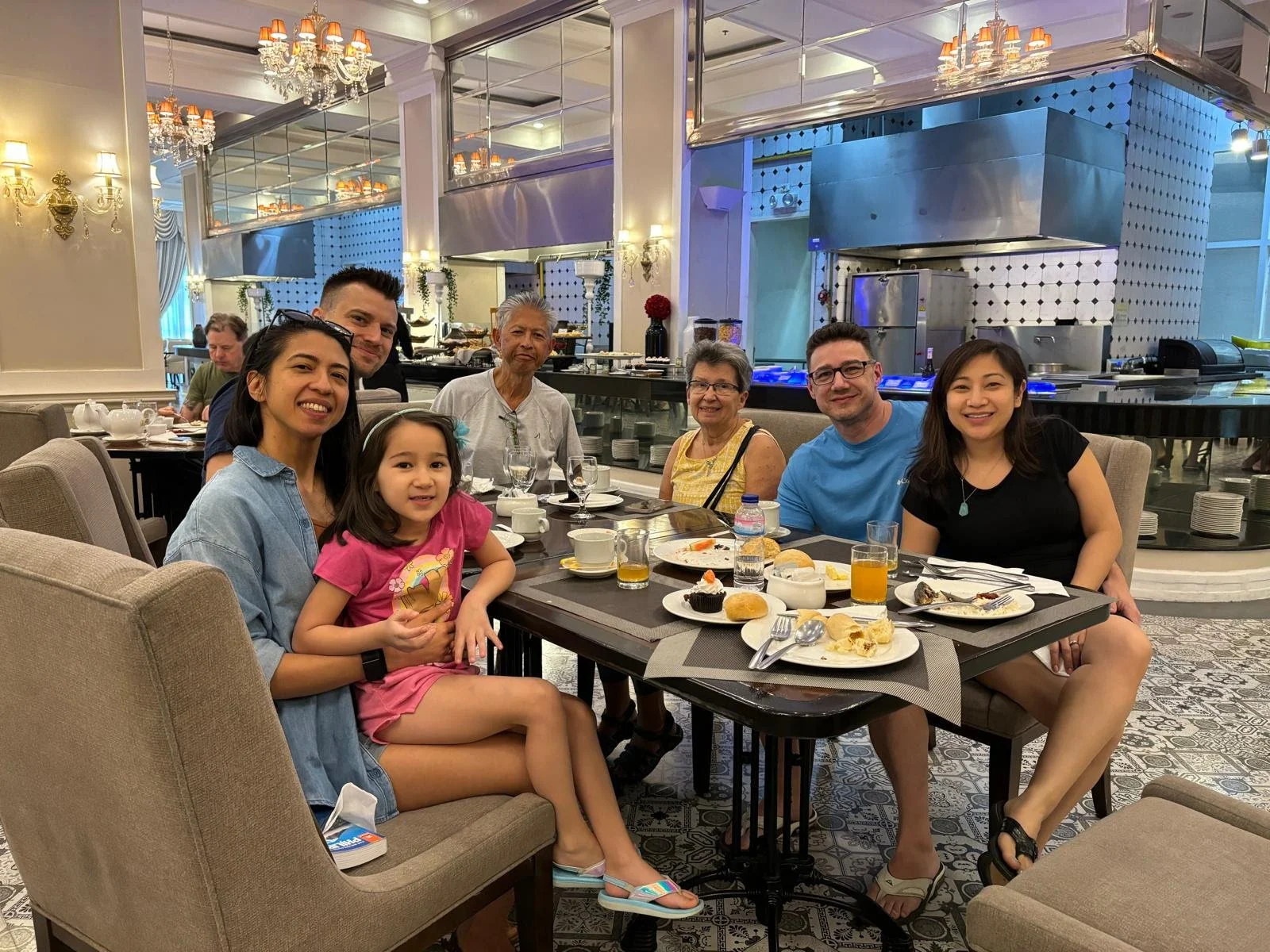
Our first morning in Manila, 2024
I knew my family still had land in Pangasinan. But I hadn’t really understood that my dad had a share in what happened to it—and that, potentially, one day, I might too.
The land was still in my Lola’s name, even though she had died almost 20 years earlier. My dad and his brothers are now in their 70s, and they were trying to finally sort out what was going to happen with it. My uncle Fred, who had spent his entire life in the Philippines and had been managing the land for decades, wanted to sell it as he prepared to retire and move from Manila much farther south to Davao, in Mindanao.
My dad and my other uncle, meanwhile, had been living in the United States for more than 40 years.
And suddenly I was being asked where I fit into all of that.
What does inheritance mean when some family members stayed and others left? And where did I fit into any of it, as someone who had grown up an entire ocean away?
My dad ultimately decided he didn’t want to fight with his brothers over the land. He was almost surprisingly matter-of-fact about it. Keeping the peace with his brothers—and actually enjoying what he believed would probably be his last trip to the Philippines—mattered more to him.
He didn’t plan to come back to the Philippines after this trip. He wanted to spend his retirement traveling the rest of the world with my mom.
And there was something about how lightly he seemed able to hold all of this that surprised me.
I had wrapped the land up in all these ideas about ancestry and belonging and what it meant to stay connected to where we came from. My dad seemed much more at peace with letting it go.
But if I wanted the land, that was different.
If inheriting his portion mattered to me, he was willing to make a case for it.
Which meant the question came back to me:
Did I actually want it?
And strangely, watching my dad be so willing to let it go taught me something about him—and maybe something about myself—that I think I needed to understand.
For a long time, I carried some sadness about what I thought of as my dad’s “colonial mindset” — and all the things I believed hadn’t been passed down to me because of it. The language. Parts of Filipino culture. Even a certain sense of connection to the Philippines itself.
I wished I had inherited more of those things from him, and I think for a long time I grieved that I hadn’t.
But standing there with him, I was starting to understand something differently.
My dad didn’t seem to regret the life he built.
He came to the United States. He became a mailman. He built a life in New Jersey with my mom. They adopted my two brothers from Ukraine. Eventually, he retired and moved to Florida. And now he and my mom travel the world because there are still so many other places they want to see.
He was living his life on his terms.
And I realized I had to respect that his relationship to the Philippines was his, just as mine was becoming mine.
But there was also another reality I had to reckon with once we got to Pangasinan:
The actual land wasn’t some romantic piece of paradise I was dreaming of living on someday.
The small parcel where my dad grew up was along a busy street, close to the neighbors, with the remains of the foundation of his childhood home still there. Another parcel, about a ten-minute drive away, was farmland with mango trees—land that would need to be managed and cared for from across an ocean.
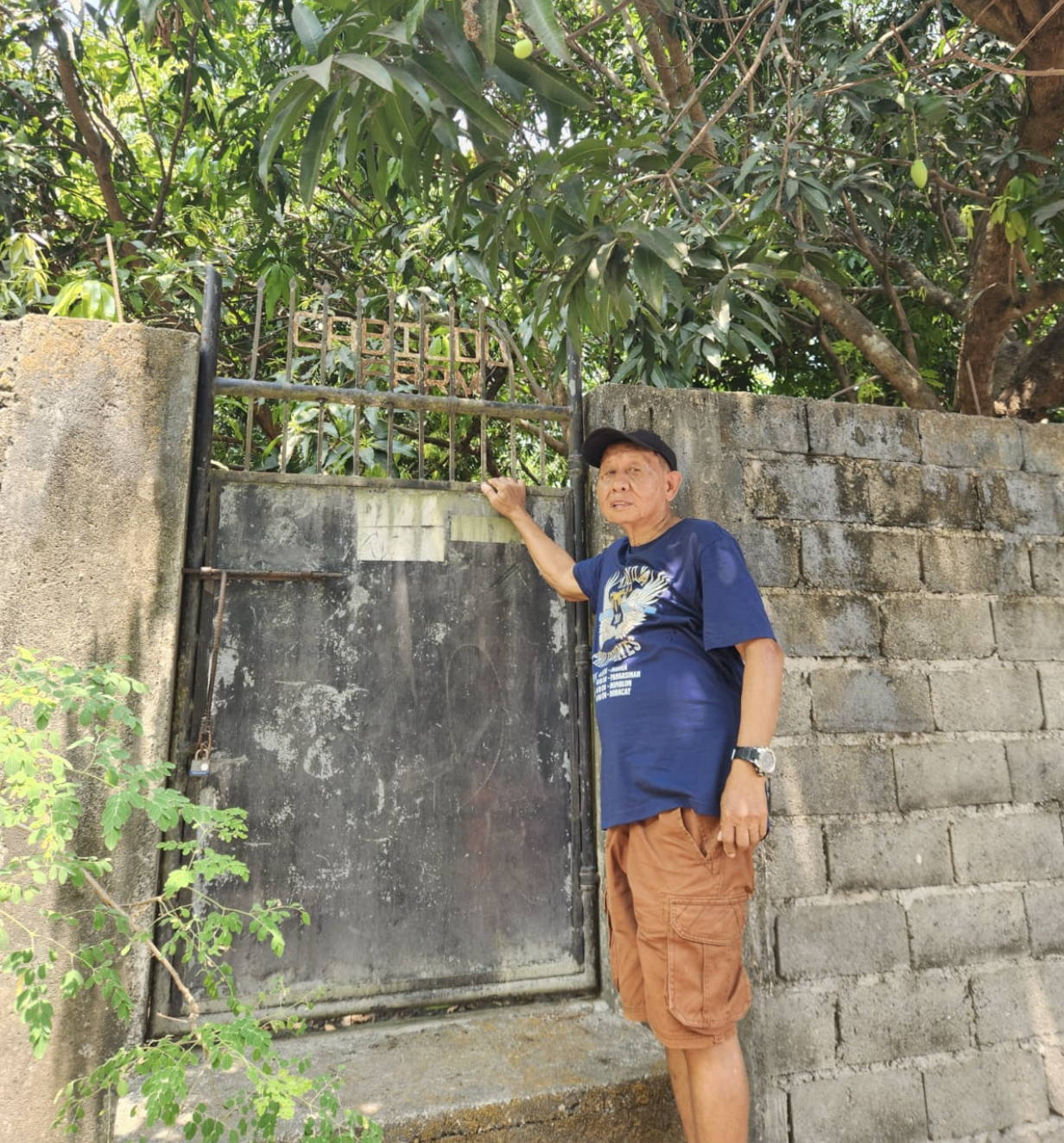
My Tito Fred at the gate to our family’s mango farm in Pangasinan, 2024.
Neither was somewhere I could really imagine myself living. If I inherited the land, it wasn’t somewhere I could imagine building a home or even necessarily staying when I came to the Philippines.
I would be inheriting land that required care. Time. Money. Relationships. Actually being there.
And yet somehow, none of that made it feel less significant to me.
Because there was the physical reality of the land, and there was everything I had imagined the words ancestral land to mean.
A place where my dad had grown up, with my Lola raising him there. A place my great-grandmother Adriana had lived. A physical piece of earth connecting my life to theirs—and to generations before them whose names I don’t even know.
The night we arrived in Pangasinan — before I had even stepped onto the land itself—I went into the hotel bathroom and cried.
I think some part of me already knew I was saying goodbye to something.
And when I finally stood there the next day, I felt something I still have trouble putting into words.
There was this strange sense of homecoming, but also this strange sense of time.
Like I was standing in a place my family had known long before I existed, and somehow my body recognized something about it even though I had never been there before.
I don’t know what that was. I still wonder about it.
What happens when generations of a family live in relationship with one place? Does some felt sense of that relationship get carried within us even if we’ve never been there? Can our bodies recognize something our conscious memories can’t?
I don’t know.
But I knew what I felt.
I felt connected backward through generations—to people who had lived and loved and survived on this land long before me.
And at the exact same time, I knew that my relationship to it was going to be different.
I wasn’t going to be the next generation to care for this particular piece of land.
And I grieved that.
I still choke up a little thinking about it.
Because what I was letting go of wasn’t simply a piece of property I particularly wanted.
I was letting go of an idea of what it might mean to remain physically connected to a place my ancestors had known—and for that relationship to continue through me.
And I think that distinction took me a while to understand.
Letting go of my claim to that particular piece of land didn’t mean letting go of my relationship to the Philippines—or to my ancestors, or even to land itself.
It meant figuring out what that relationship was going to be for me.
For me, so much of that has happened through my body. Through Filipino martial arts. Through CKC. And through asking what it means to live in relationship with the land wherever I am.
And maybe there are things I inherited from my dad that I didn’t always recognize as inheritance.
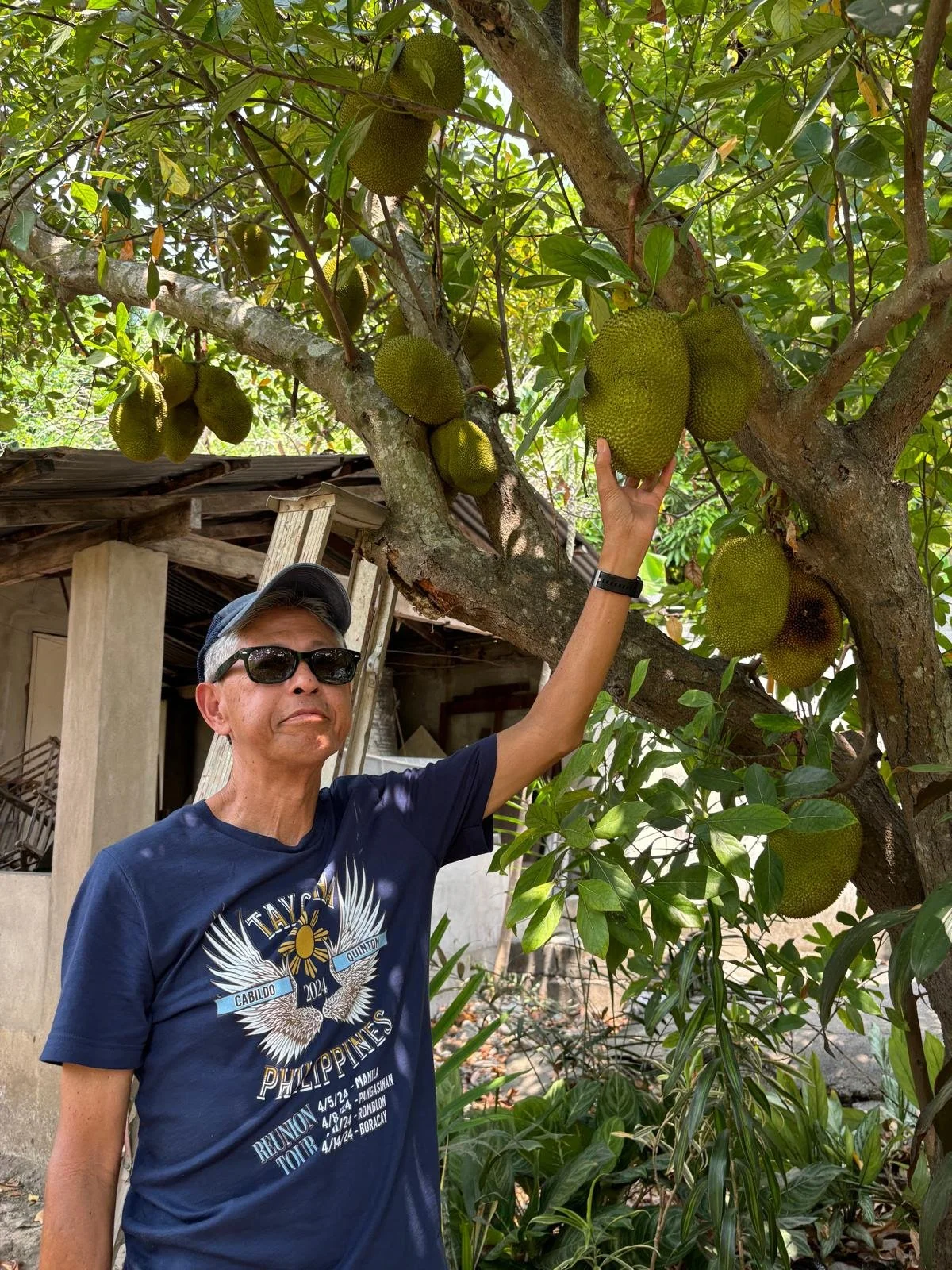
My dad on the land where he grew up in Pangasinan, 2024.
For a long time, I think I saw some of his choices mostly through the lens of what I felt I had lost because of them.
And maybe some of that was true.
But it wasn’t the whole story of my dad.
My dad loves life.
He’s funny. He’s lighthearted. He’s been through hard things, and somehow, even in his 70s, he still carries this lightness with him. He adapts. He gets excited about where he’s going next. And he seems genuinely happy with the life he’s built.
Maybe some of that was shaped by survival, migration, and all the forces I’ve spent so much time trying to understand.
And maybe some of it is also just my dad.
Making room for that somehow frees something in me.
I can grieve what wasn’t passed down to me without believing I have to recover all of it. I can love where I come from deeply and still be curious about where my own life might take me.
And maybe I inherited some of his lightness, too.
And I think all of this has changed the way I understand inheritance.
Because I may not inherit this particular piece of land. But that doesn’t mean there’s nothing here for me to inherit.
There’s something older: an understanding that our relationship with land matters.
And that leaves me with a question I’ve already been trying to live:
How do I live in right relationship with the land wherever I am?
Right now, wherever I am is New York City. Someday it may be somewhere else.
And I imagine what that asks of me will keep changing.
Maybe that’s the point. It isn’t something I figure out once. It’s a relationship that keeps evolving.
And yours might look completely different.
Maybe you feel called to return to your family’s land or care for it in some way. Maybe your life moves between here and the Philippines. Or maybe your relationship to land is taking shape somewhere else entirely.
Some of us may not have family land to return to at all.
How we each live that question is going to be different.
And this is exactly the kind of question we explore inside Chrysalis Kali Collective.
Tomorrow, I’m welcoming Nicole Reyes into CKC for a conversation about our relationship to ancestral land.
Nicole’s own relationship to her family’s land has taken her in a different direction than mine, and I’m really looking forward to putting some of these questions into conversation with her—and with the CKC community.
Nicole also created “We Have Land in the Philippines”: An Ancestral Land Starter Guide to help Filipinos in the diaspora begin looking into their own family land—from the practical questions around titles, taxes, inheritance, and what’s actually there, to the family stories, relationships, and histories connected to it.
You can sign up for Nicole’s guide here.
And if reading this brought up your own questions, memories, or stories around land, inheritance, or belonging, you’re welcome to come explore them with us tomorrow.
Our Relationship to Ancestral Land with Nicole Reyes
Tomorrow — Tuesday, October 6
6:30pm ET / 3:30pm PT
Live inside the Chrysalis Kali Collective online membership
JOIN CHRYSALIS KALI COLLECTIVE
Doors to CKC are open now through October 12.
Ingat,
Guro Kristen